Projects
Digital money foundation
Digital money and tokenisation are often discussed in terms of technological possibility. This new series asks a narrower economic question: when does blockchain or tokenisation add marginal value compared with existing financial instruments, schemes and infrastructures?
The economic rationale of blockchain
October 2026
Blockchain’s distinctive contribution lies in governance and infrastructure economics. Its relevance depends on where it enters the financial transaction stack and whether its marginal benefit exceeds the cost and complexity of adding another layer to the financial system.
Recent insights

Money and sovereignty: The wrong debate
Bangkok, 15 October 2026
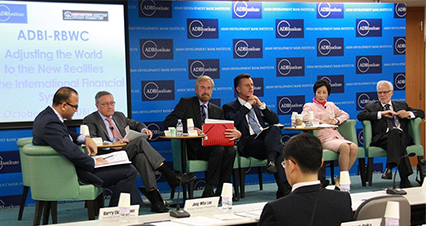
I attended a roundtable today organised by Oliver Wyman and Marc Uzan of Reinventing Bretton Woods Committee during the International Monetary Fund in Bangkok on sovereignty, strategic technology dependence and institutional agency. The discussion raised concerns that foreign currency-denominated stablecoins could undermine monetary sovereignty. I question both the materiality of the concern and the framing of the debate.[...]
IMF Annual Meetings: We need to talk about cross-border payments
Bangkok, 12 October 2026
The International Monetary Fund Annual Meetings are underway in Bangkok, Thailand. The Meetings are one of the largest gatherings of central bankers and finance ministry officials. But how well do the Meetings reflect countries’ top policy priorities? Possibly not enough.[...]
Blockchain in payments: from technological possibility to economic rationale
Cebu, 8 October 2026
This is to share that I had the pleasure to participate in a research conference organised by the Bangko Sentral ng Pilipinas and Reinventing Bretton Woods Committee in Cebu, Philippines on 7 October. As blockchain continues to be proposed as a solution to payment problems, I wanted to ask: what actually is the economic rationale for using blockchain?[...]
Recent commentary
Concept note: MiCAR and stablecoin multi-issuers
Economics Advisory,
Multi-issuer stablecoins can in principle be subject to redemption requests for stablecoins issued by any of the multiple issuers. In the EU, it has led to a debate about the adequacy of current provisions under the Markets in Crypto Assets Regulation (MiCAR). However, the current debate risks unduly conflating technical and operational fungibility with statutory claims. MiCAR unambiguously designates a stablecoin as a claim against the issuer. However, traceability of stablecoins is necessary to be consistent with MiCAR provisions.
Concept note: Stablecoins and the singleness of money
Economics Advisory,
The notion of singleness of money has been used increasingly to qualify payment instruments as money.Stablecoins have been labelled as “failing the test of singleness.”
The notion of singleness has its historical foundation as singleness of currency in the establishment of monetary unions and fungibility under decentralised currency issuance. The concept needs to be revisited to ensure it can guide public policies effectively and does not lead to an unwarranted bias against certain monies.
Impact of stablecoins on monetary policy
Economics Advisory,
The emergence of stablecoins has raised concerns about their potential impact on the transmission of monetary policy and financial stability. At first sight, there is no compelling evidence suggesting that stablecoins similar to other prepaid instruments may impair monetary policy. The impact will likely depend largely on possible shifts in preference for holding transaction balances, a recomposition of bank liabilities and risks of increasing dollarisation but will be highly dependent on initial local conditions.[...]
The EU should embrace decentralised finance and make it safe
Economics Advisory,
Decentralised finance now forms an integral part of the wider public policy discussion, including at the highest level. But I would argue often for the wrong reasons. I believe the discussion would be far more advanced if there were a greater common understanding of why and how certain elements of decentralised finance could have a major impact on the financial system. [...]
The UK stablecoin is already here—Scottish banknotes
LSE Business Review Blog,
While concerns about stablecoins and their possible impact on financial stability remain, the instrument is not as new as people may assume. One country within the United Kingdom has one of the world’s oldest stablecoin regimes – in paper form. Scottish banknotes offer a reminder that the co-existence of stablecoins with other monies need not be controversial. Moreover, Scottish banks seem able to leverage existing regulation to move sterling “on-chain”.[...]
Which is the fairest of all tokenised monies
OMFIF Digital Monetary Institute, 13 March 2026
If widely adopted, tokenised money market funds may become one of the most consequential innovations in wholesale liquidity management.
As markets explore tokenised deposits and stablecoins, tokenised money market fund shares deserve equal attention, given their high credit quality, interest-bearing nature and institutional familiarity. Not only does tokenisation bring considerable benefits to money market fund shares, it changes how institutional liquidity is managed, shifting it from redemption towards circulation. It transforms money market funds from a passive savings vehicle to a multi-purpose financial instrument. [...]
The UK needs to press ahead with digital gilts plans
Financial Times, 29 January 2026
The UK government has been preparing to launch the most consequential state initiatives on the tokenisation of financial assets. The UK now needs to press ahead with a decision on the tender and subsequent development. The instrument, dubbed the Digit, could be the catalyst that brings tokenised money and assets more into the financial mainstream. While some countries like China have issued digital currencies, this would be the first issuance directly on a blockchain of tokenised treasury security by a G7 country. [...]
Services
Strategic advice
Consultation on monetary innovation, central bank digital currencies (CBDC), private digital monies and other blockchain-based financial and payments applications with a focus on cross-border payments and securities settlement.
Speaking
Event and keynote addresses and panel discussions on digital monies and assets and international monetary affairs.
Publications
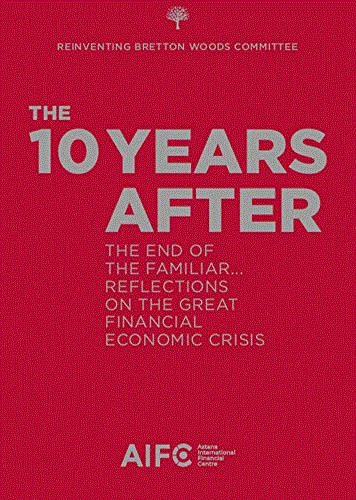
Two key publications by the Reinventing Bretton Woods Committee on international monetary affairs are now available on Amazon:

About
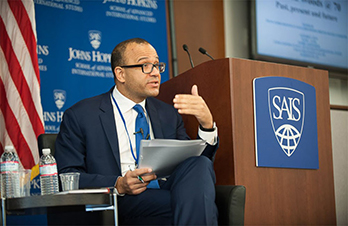


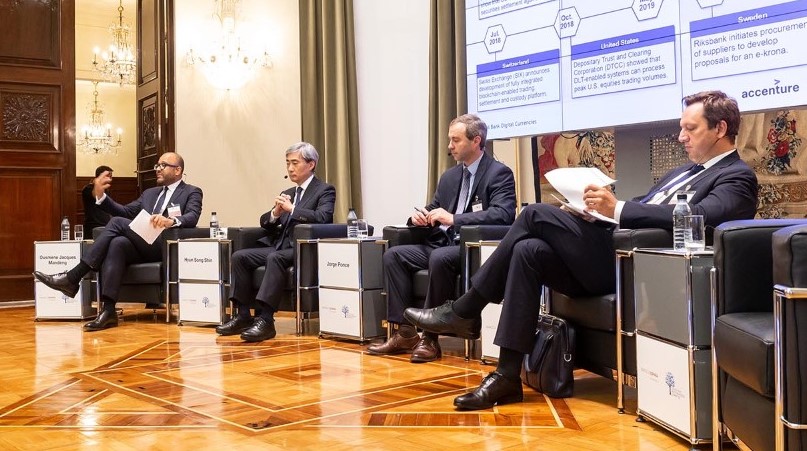
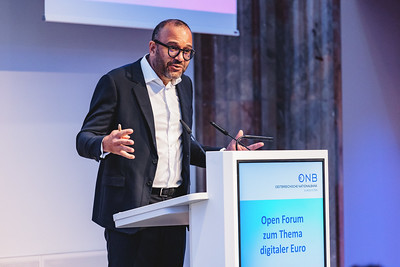
Economics Advisory Ltd. is a London-based private limited company registered in England and Wales established in 2018 with a special focus on tokenised money and payments solutions led by Ousmène Jacques Mandeng.
Ousmène Jacques Mandeng is the founder of Economics Advisory. He specialises in the economics of tokenised monies, their impact on financial markets and the digital transformation of finance. He is acting as Senior Advisor to Accenture on major tokenised money projects and in particular central bank digital currencies. Ousmène had worked more than 20 years in senior positions in financial markets and the International Monetary Fund. He comments regularly on the impact of digital money and the international monetary system.
Ousmène Jacques Mandeng is a Visiting Fellow of the London School of Economics and Political Science, Member of the Bretton Woods Committee, Fellow of the Reinventing Bretton Woods Committee, Member of Robert Triffin International. He is fluent in German, English, French and Spanish and holds a PhD from the LSE.
All views expressed in this blog are those of Economics Advisory and not necessarily those of its clients.